Q 1: Why did you choose 1973 as the start year?
A: Firstly, IKEA Strategy 1973 marked the first full year after IKEA’s German expansion and the debut of large scale flat pack logistics. It is therefore the moment the four principles visibly. Intertwine and measurable data becomes consistent.
Q 2: How big was IKEA by 2013 in headline numbers?
A: In summary, the company ran 349 stores, sourced from more than 1 000 factories. Employed about 135 000 people, and posted €27 billion in revenue. These scale figures contextualize every metric discussed later.
Q 3: IKEA Strategy. What is “Community Integrated Scale” in one sentence?
A: In short, it is growth that embeds production, jobs, and social programmes inside the host community. So economic scale reinforces local well being instead of bypassing it.
Q 4: Give a concrete example of that principle.
A: Overall, the BoKlok joint venture with Skanska supplied over 5 000 low-energy timber homes. In Sweden by 2011 while keeping purchase prices 25 percent below comparable housing.
Q 5: Did community integration boost financial results or just reputation?
A: Both. Across regions, Polish supplier localisation cut logistics cost up to 30 percent on selected lines and grew. European production share to 18 percent, supporting IKEA’s margin discipline.
Q 6: How does Modular Ecosystem Design differ from plain modular products?
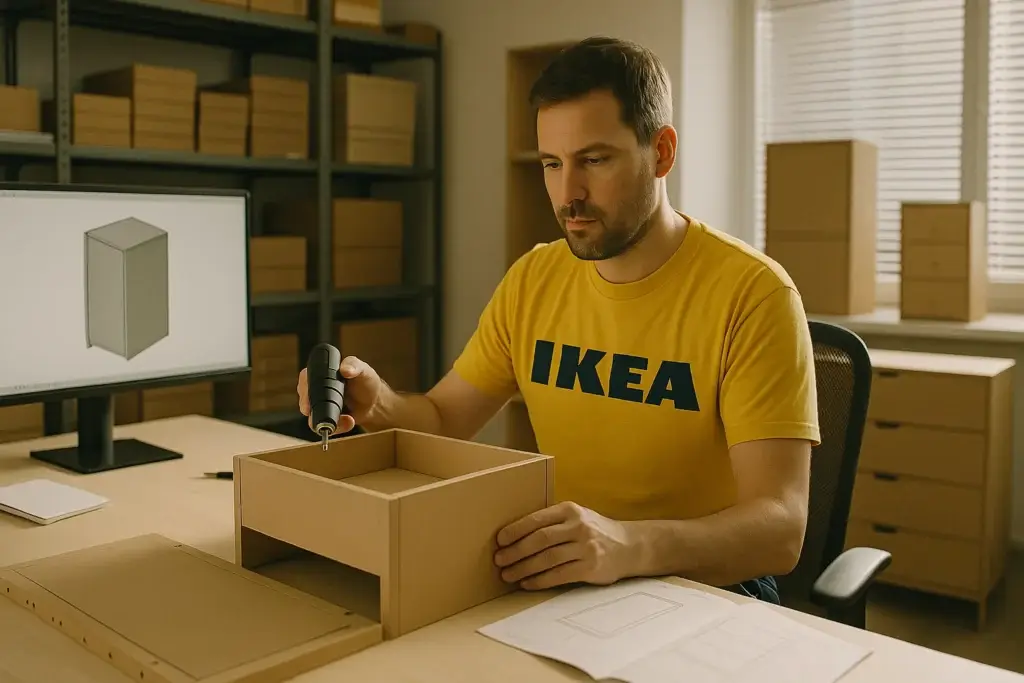
A: In summary IKEA standardized not only the end items but also the screws, hinges, pack sizes, and supplier contracts, creating an end to end module network that slashed cost and sped redesigns.
Q 7: What is the iconic case IKEA Strategy?
A: In fact the BILLY bookcase. By 2009 it sold 41 million units, all using an interchangeable shelf panel architecture that enabled component upgrades without full re tooling.
Q 8: How large was the logistics impact of flat-pack design?
A: To sum up average shipment volume per item fell by up to 90 percent compared with pre flat pack equivalents, eliminating roughly 7 000 truckloads on six flagship SKUs between 2005 and 2010.
Q 9: Could that modular logic apply to EcoWave.Green?
A: Yes. For example, standardizing planter boxes, facade anchors, and irrigation couplets would mirror IKEA’s bolt-on approach, cutting install time and transport emissions while easing maintenance.
Q 10: What hard evidence supports IKEA’s kaizen culture?
A: To conclude, across 140 000 cataloger entries from 1994-2010, real prices dropped 1.9 percent annually while gross margins stayed above 10 percent, proving efficiency gains offset price cuts.
Q 11: Did that mindset touch sustainability?
A: Yes. Above all, North American stores cut electricity use 15 percent in two years via lighting retrofits, showing kaizen extended to environmental performance as well.
Q 12: How might EcoWave.Green copy the kaizen system?
A: In conclusion, institute a 2 percent yearly material intensity reduction target for every rooftop square meter installed, funding R&D from the savings exactly as IKEA funded expansion.
Q 13: What does “Agile Pivot & Resilience” really mean?
A: That is to say, the organisational capacity to sense shocks quickly regulatory, ethical, or supply and reconfigure processes fast enough to protect brand trust and cash flow.
Q 14: What crisis best illustrates IKEA Strategy agility?
A: For instance, the 1992 German formaldehyde scandal. IKEA halted white BILLY sales, reformulated coatings, and resumed indeed, production in twelve weeks at a cost below US $7 million.
Q 15: Are there measurable paybacks from such pivots?
A: Afterward, post crisis sales growth recovered to a six percent compound rate, and market share in Germany stabilized, indicating that swift action contained long term damage.
Q 16: What lessons does this hold for EcoWave.Green?
A: Indeed, draft recall and audit playbooks before expansion. Rapid transparency converts inevitable slippage into credibility moments, mirroring IKEA’s crisis to trust conversions.
Q 17: IKEA Strategy, How do the four principles reinforce one another?
A: Above all, community roots justify modular design investment; modularity produces granular data for continuous improvement; kaizen generates capital that funds agile pivots; agility in turn protects community trust, closing the loop.
Q 18: Summarize the single biggest takeaway for sustainability ventures.
A: As mentioned earlier, profitability and planet positive impact are not trade offs: when scale, modularity, kaizen, and agility operate as an integrated flywheel, commercial success funds social and environmental progress rather than obstructing it.
Closing Reflection IKEA Strategy
That is to say, history rarely hands us four decades of controlled experiments. IKEA’s journey from 1973-2013 is the rare case where management choices, metrics, and outcomes align clearly, in short, enough to serve as a blueprint. EcoWave.Green can adapt that blueprint to green rooftops, vertical gardens, and circular urban services. The mechanics are different; the principles endure.
References IKEA Strategy
- Gustavsson, M. (2006) Evaluating Packaging Logistics Development at IKEA. MSc Thesis, Lund University. Available at: https://lup.lub.lu.se [Accessed 5 July 2025].lup.lub.lu.se
- IKEA Museum Digital Archive. Available at: https://ikeamuseum.com [Accessed 5 July 2025].ikeamuseum.com
- Inter IKEA Systems B.V. (2009) BILLY Facts: 30 Years. Delft. Available at: https://en.wikipedia.org/wiki/IKEA_Billy [Accessed 5 July 2025].en.wikipedia.org
- Kratz, C. (2011) ‘BoKlok – Ready for the Big World’, Skanska Global Newsroom, 12 Mar. Available at: https://group.skanska.com [Accessed 5 July 2025].group.skanska.com
Read More:
IKEA History >>>
IKEA Analysis >>>
Living Labs Infrastructure >>>
Net Zero Precinct Programs >>>
Life Cycle Economics >>>