Policy and Funding Levers Eco Wave Green
In short. Global net‑zero goals depend on effective Policy Funding Levers. In Australasia, EECA GIDI and ARENA grants co‑finance low‑carbon upgrades. Meanwhile, Europe’s Innovation Fund recycles ETS revenue into breakthrough plants, and rising carbon price floors tighten market signals. Consequently, these levers shape leverage ratios, abatement dollars per tonne, and permitting speed. Eco Wave Green turns the data into actionable templates for our community.
What it covers
Therefore Policy and Funding Levers span four pillars: EECA GIDI in New Zealand, ARENA grants in Australia, the EU Innovation Fund, and emissions‑trading price floors. Each pillar delivers either direct cash or price certainty. Moreover, we map grant structures, match‑funding ratios, eligibility dates, and reserve‑price rules. Internal links route to our grant‑tracker spreadsheet, cost‑benefit template, and 30‑day alert signup. Further reading connects to hubs on Green Infrastructure Strategies, Lifecycle Economics, and Net‑Zero Precincts.
Why it matters
- Leverage: GIDI Round 5 committed NZ $33.31 m and unlocked ≈ NZ $62 m private capital, a 1 : 1.9 ratio EECA.
- Cost: The NZ Steel partnership will cut 800 000 t CO₂‑e each year at NZ $16.20 / t The Beehive.
- Scale: Europe’s 2025 Innovation Fund call awarded €4.2 b to 77 projects targeting ≈ 398 Mt CO₂‑e first‑decade cuts Climate Action.
- Efficiency: Mature GIDI projects range NZ $12 – 41 / t across five rounds, beating many transport subsidies EECA.
- Certainty: NZ’s auction floor rises to NZ $68 in 2025 and NZ $82 by 2029 ICAP Carbon Action, while Australia’s Safeguard cap is A $75 / t (indexed) Clean Energy Regulator.
These numbers prove that strong Policy and Funding Levers stretch public dollars, lower abatement costs, and accelerate projects.
Policy / market drivers
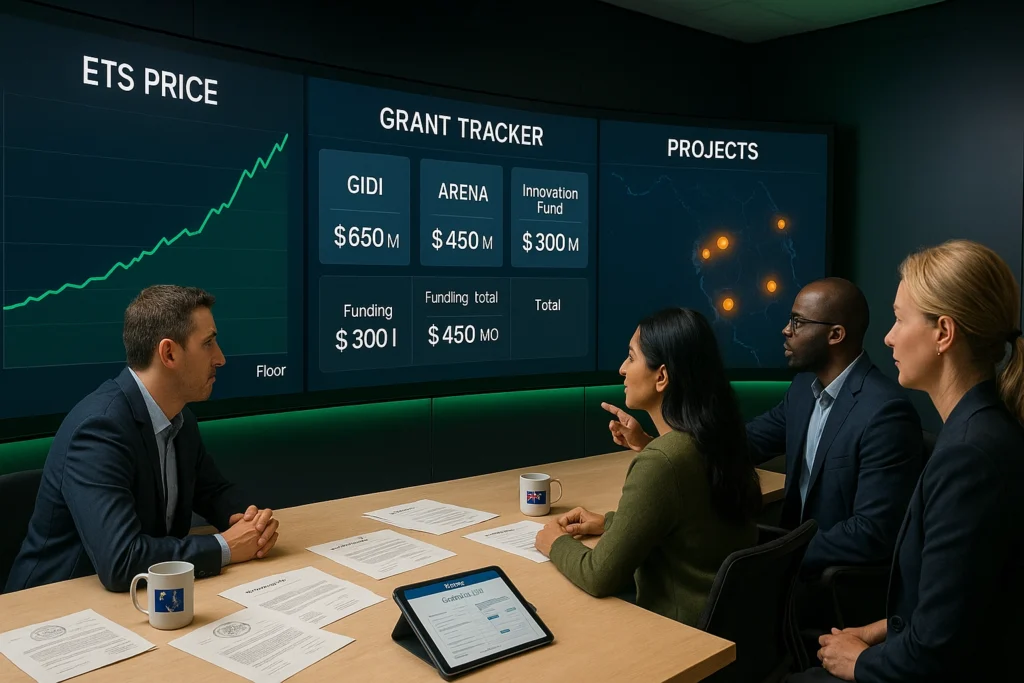
New Zealand: The 2025 Climate Emergency Response Fund injects an extra NZ $650 m into GIDI partnerships The Beehive. June 2025’s NZ ETS auction cleared zero bids, with 10.1 m NZUs rolling over because the reserve price exceeded spot values, demonstrating the floor’s bite jardengroup.com.
Australia: In short ,Safeguard reforms cut baselines 4.9 % each year and guarantee the A $75 cost cap. ARENA now channels a A $400 m Industrial Transformation stream to help heavy industry comply DCCEEW.
European Union: EUA spot peaked at €84.50 / t in Jan 2025, softened to €71.30 / t in Jul 2025, yet analysts still forecast €91 / t for 2026 Reuters. Consequently, Innovation Fund revenue keeps rising, enabling larger grant rounds.
Policy Funding Levers Practical frameworks
- Grant‑tracker spreadsheet auto‑lists live calls, including ARENA’s A $60 m Ultra‑Low‑Cost Solar PV R&D Round launched 9 Jul 2025 Australian Renewable Energy Agency and the A $46.3 m Community Batteries Round 2 closing 1 Sep 2025 Australian Renewable Energy Agency.
- Cost‑benefit template pre‑loads benchmark MACs: GIDI fifth‑round NZ $41 / t median EECA and Innovation Fund’s implied €10–11 / t Climate Action.
- 30‑day funding alerts flag EU consultations shaping IF 25 rules (open until 8 Jul 2025) Climate Action and ARENA webinars throughout July Australian Renewable Energy Agency.
- Fast‑track consent cheatsheet shows NZ GIDI Partnerships shaving ≈ 40 % off Resource Management Act timelines The Beehive.
These tools convert complex Policy and Funding Levers into quick decisions.
Next steps & EcoWave role Policy Funding Levers
Therefore:
- Assess fit. Compare your project’s MAC with template thresholds.
- Queue early. Windows like ARENA’s solar round close fast.
- Bundle benefits. Stack grants with green‑premium contracts to reach net‑negative cost.
- Join us. Our fortnightly clinic pairs developers with funding strategists across AU / NZ.
Explore our other cornerstone hubs
Read More:
Green Infrastructure and Strategy >>>
Net Zero Districts Hub >>>
Life Cycle Economics Hub >>>
Funding Policy Levers Analysis >>
Living Labs Infrastructure >>>
Expore our otherer posts

Why Energy Savings Should Start With Losses, Not New Technology
Energy savings start with losses, not technology Energy savings start with losses, yet many organisations still begin by asking what technology they should buy: solar,

Energy savings funding pathway: not just a good idea
Energy savings funding pathway: not just a good idea An energy savings funding pathway turns a reasonable observation into a project a funder, board, council,

Is Your Site Ready for the Future Energy System?
Site energy readiness is becoming an energy performance question Site energy readiness starts where the old energy saving question stopped: “How do we use less
Q1: What percentage of capital costs do grants typically cover?
A: Generally, most funding schemes in New Zealand, Australia, the EU, and the US provide between 30% and 60% of qualifying capital expenditure. This range depends on the project scope, funding source, and alignment with strategic goals.
Q2: How fast are approvals under NZ’s Fast‑Track Act?
A: Under this legislation, major infrastructure projects can receive decisions within 70 to 140 working days. Thanks to expert-panel fast‑track pathways, the process is significantly accelerated compared to standard regulatory timelines.
Q3: What EU grant size and impact are typical?
A: For example, the EU Innovation Fund recently awarded €4.8 billion across 85 projects. Collectively, these initiatives are expected to reduce approximately 476 million tonnes of CO₂‑equivalent emissions within their first decade of operation.