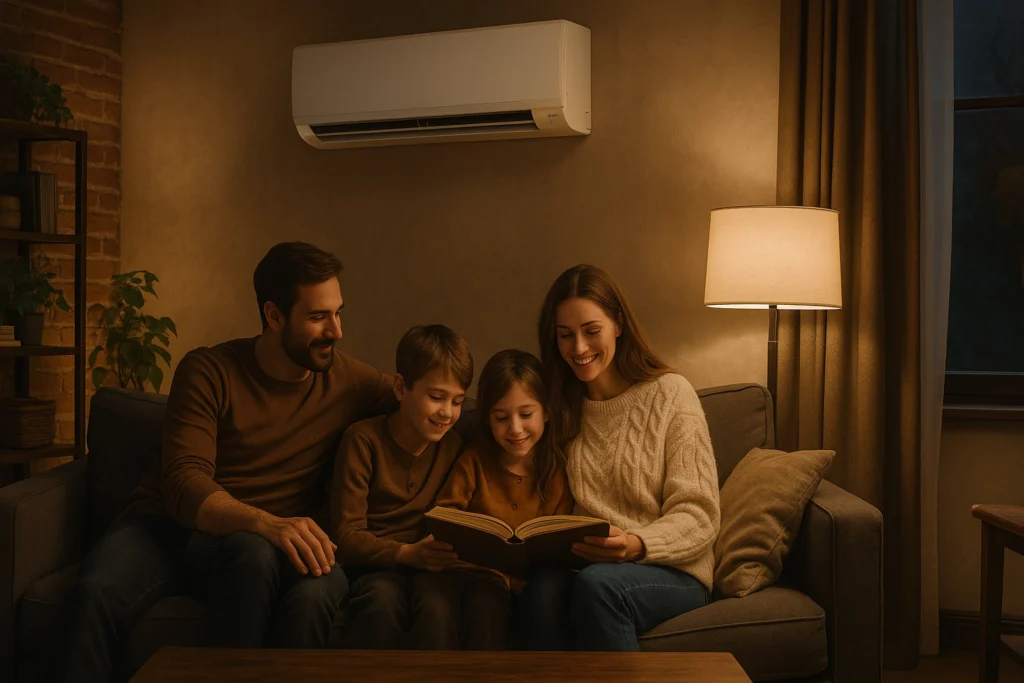
Why Heating Matters for a Healthy Home
Keeping your home warm isn’t just about comfort it’s about health.
The World Health Organization recommends a minimum indoor temperature of 18 °C to protect against cold-related illness.
New Zealand’s Residential Tenancies (Healthy Homes Standards) Regulations 2019 (via Tenancy Services) sets a standard for rental properties: the main living room must be able to reach this safe temperature. (Tenancy Services) [1]
What Counts as a “Qualifying Heater”
Your main living area must have a **fixed heater** — not a portable one — that can deliver at least **1.5 kW** of heating power. It also must include a thermostat if it’s electric or a heat pump. (Tenancy Services) [1]
Old-style **open fires** or **unflued gas heaters** are unacceptable because they waste energy and can cause dampness or health risks. (Tenancy Services) [1]
If the living room needs more than **2.4 kW** of heat, you’ll need a heat pump or another efficient system — a simple plug-in heater won’t suffice. (Tenancy Services) [2]
How Much Heating Power Do You Need?
The goal is: your heater must keep the **main living room at 18 °C**, even on the coldest days.
You can work this out using the official **Heating Assessment Tool** from Tenancy Services. [3]
For modern homes built to the 2008 Building Code or apartments in larger buildings, smaller heaters may still meet the requirement because these homes hold warmth better. [3]
Combining Heaters and “Top-Ups”
Sometimes one heater isn’t enough — that’s fine.
You can combine more than one qualifying heater as long as together they meet the required capacity.
If your property already had a large fixed heater before **1 July 2019**, you might only need a small **top-up heater** (up to **2.4 kW**) to meet the new standard. [1]
For Apartments and Shared Buildings
If installing a full heat-pump system isn’t practical — say, in an apartment where you can’t add an outdoor unit — landlords must still install at least **one fixed heater of 2 kW or more**. This ensures tenants still have a safe, warm space to live in. [1]
Proof of Compliance
Every tenancy agreement must include a **Healthy Homes compliance statement**. This lists each heater’s power rating and how the heating meets the required standard. (Tenancy Services) [4]
Landlords must keep records — including tool results, photos, or professional reports — and provide them within 21 days if tenants ask. (Tenancy Services) [5]
Penalties for Non-Compliance
Ignoring heating obligations can lead to **fines up to NZD 7,200**. (Tenancy Services) [1]
All private rentals must comply by **1 July 2025**, while Kāinga Ora and community housing providers had earlier deadlines. (Tenancy Services) [6]
Quick Action Plan
- Identify your **main living room**.
- Use the **Heating Assessment Tool** to find your target kW. [7]
- Choose a **fixed, thermostat-controlled heater** that meets or exceeds it.
- Avoid unflued or open-flame heaters.
- Keep your documentation ready for inspection. [4]
FAQ — Heating Standard Made Simple
Q1: What’s the minimum temperature my home must reach?
A: 18 °C in the main living area — the same level recommended by WHO and adopted in NZ law.
Q2: Can I use a portable heater?
A: No. The heater must be **fixed** to the property. [1]
Q3: Are gas heaters still allowed?
A: Only if they are flued and meet the efficiency and safety requirements. **Unflued** gas heaters are not acceptable. [1]
Q4: What if I already have a good heater?
A: If it meets **80%** of the required output and was installed before **1 July 2019**, you may only need a **small top-up heater**. [2]
Q5: I live in an apartment — do I still need a heat pump?
A: Not necessarily. If installation isn’t practical, a smaller qualifying heater (≥ 2 kW) may be acceptable. [1]
Q6: How do I prove compliance?
A: Keep your **Heating Tool result**, installation details, and fill in the **section 13A statement** (compliance statement). [4]
Q7: When’s the deadline?
A: All private rentals must comply by **1 July 2025**. [6]