Executive Summary
Funding Policy Levers to sum up, across the four jurisdictions EcoWave.Green monitors. Public capital for climate aligned projects has swelled since July 2023. Also New Zealand’s EECA “GIDI Partnerships” committed NZ $230 million. That leveraged NZ $860 million in private funds to deliver a forecast 9.3 Mt CO₂‑e lifetime abatement. Australia’s ARENA closed, due to an oversubscribed A $70 million. Industrial Transformation Stream round on 15 July 2025 and, days earlier, opened a A $60 million call to push solar costs below A $20 / MWh. The EU remains the heavyweight: its 2024 Innovation Fund. Awarded €4.8 billion to 85 projects expected to cut 476 Mt CO₂‑e in their first decade in the United States.
The Inflation Reduction Act channelled US $1 billion into 385 urban‑forestry projects, extending canopy cover for heat‑island relief nationwide. These grant pools share a common design covering 30‑60 % of capital costs while demanding verified emissions or resilience metrics which sharply improves payback periods for recipients.
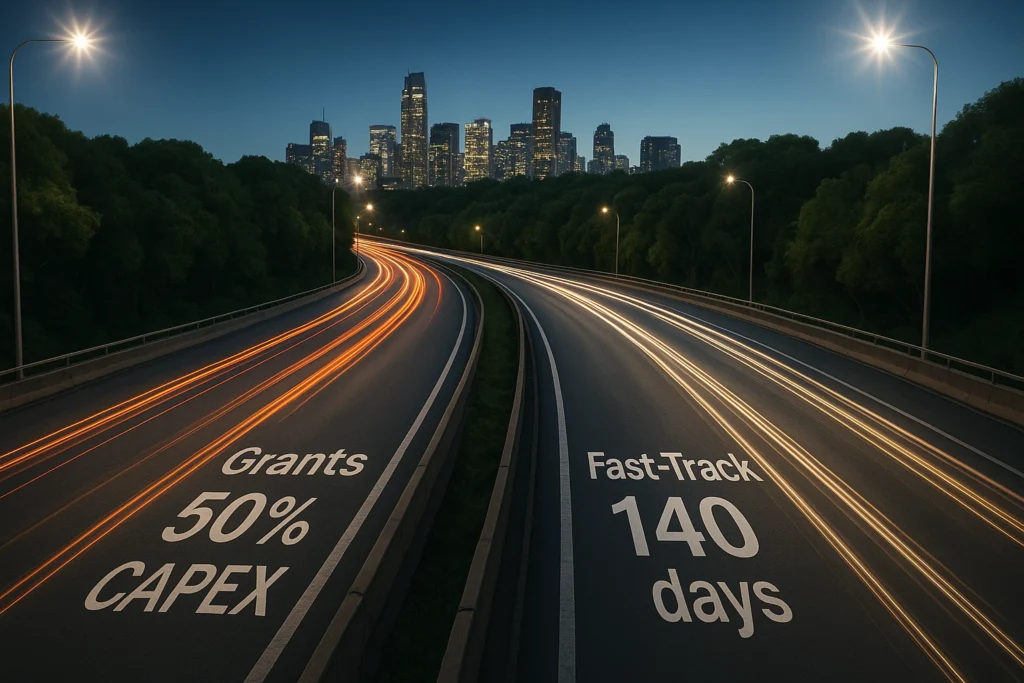
Parallel regulatory reforms now compress delivery timelines. New Zealand’s Fast Track Approvals Act, in force since December 2024, routes nationally. Significant builds through expert panels, trimming consenting to roughly 3‑6 months. Germany has already permitted 7.8 GW of onshore wind in H1 2025, with average reviews down to 18 months a 20 % acceleration. After EU‑mandated streamlining. The US FAST‑41 framework reports a 45 % cut in federal environmental impact statement timelines, averaging 2.5 years for 29 major projects. Thus for EcoWave.Green, this combination of richer grants and faster approvals lowers both capital and schedule risk.
By aligning proposals with funded categories industrial decolonization, ultra low cost solar, urban cooling, or water smart infrastructure the project can secure substantial co investment and reach operation sooner, strengthening ROI for clients and accelerating measurable climate benefits.
Momentum Shifts in Public Climate Finance
Governments are pouring fresh capital into projects that slash emissions and cool cities. Consequently, EcoWave .Green now faces a funding landscape far deeper and faster than even two years ago. Moreover, streamlined approvals are clipping months sometimes years from delivery schedules, so winning grants now translates into near term construction rather than distant hopes. Therefore, understanding where the money is flowing and how quickly consents arrive has become mission critical.
Where the Money Is Flowing: Grants & Rebates
Although programme designs differ, nearly every scheme pays 30 – 60 % of capital costs, pushing paybacks below a decade.
New Zealand – GIDI Fund
- NZ $355 m public co‑funding backed 119 projects between 2020‑23, leveraging NZ $890 m private capital (IEA).
- Lifetime abatement: 6.6 Mt CO₂‑e, equal to removing 1.6 m cars for a year.
New Zealand – GIDI Partnerships
Two supersized deals (NZ Steel, Fonterra) secured NZ $230 m public support; projected cut 9.3 Mt CO₂‑e by 2035 (MBIE).
Australia – ARENA Industrial Transformation Stream, Round 2
- A $70 m pool, applications closed 15 Jul 2025 after heavy oversubscription (Australian Renewable Energy Agency).
- Earlier portfolio analysis shows 24 % IRR and 6.6‑year paybacks when ARENA co‑funds (Australian Renewable Energy Agency).
Australia – Ultra‑Low‑Cost Solar R&D
- New A $60 m round aims for utility‑scale PV at < A $20 / MWh (Australian Renewable Energy Agency).
European Union – Innovation Fund (IF23)
- €4.8 bn awarded to 85 projects; expected to avoid 476 Mt CO₂‑e in first decade (European Commission).
United States – Urban & Community Forestry Grants
- US $1 bn pumped into 385 projects planting shade trees to combat heat‑islands (USDA).
Why it matters Funding Policy Levers
Furthermore, each region now offers specific niches—industrial fuel‑switching in NZ, ultra‑cheap solar in AU, heavy‑industry pilots in the EU, urban greening in the US—allowing EcoWave .Green to match solutions with ready cash.
Cutting Red Tape: Fast‑Track Approval Pathways
Because capital is only half the battle, policy‑makers are also slashing red tape. Consequently, project schedules that once spanned years now compress into months.
- NZ Fast‑Track Approvals Act 2024: expert panels replace standard Resource Management Act hearings; target timelines ≈ 70‑140 working days (Legislation.govt.nz).
- NZ Implementation Insight: Dentons reports wide applicant uptake across housing, renewables and mining as of 14 Jul 2025 (Dentons).
- Australia – Victoria Priority Projects: renewable builds deemed “significant economic developments,” receiving ministerial sign‑off in ≈ 4 months (Australian Renewable Energy Agency).
- Germany: 7.8 GW onshore‑wind permits cleared in H1 2025; average consent time 18 months (‑20 %) (Reuters).
- United States – FAST‑41: federal EIS reviews now average 2.5 years, a 45 % cut versus 2010‑18 baseline (Performance.gov).
Therefore, EcoWave .Green can pair funding bids with assurance that construction windows stay tight, preserving IRR assumptions.
Reading the Scoreboard: Award Rounds & Performance Metrics
Notably, mature schemes publish hard numbers, proving climate impact and financial leverage.
- GIDI Rounds 1‑2: 6.6 Mt CO₂‑e lifetime cuts for NZ $56 m public outlay (IEA).
- BASIX (NSW): over 500 000 homes since 2004 have saved 340 bn L water and 12.3 Mt CO₂‑e (Planning NSW).
- ARENA Community Batteries, Round 2: A $46.3 m budget expects > 370 MWh storage serving > 100 000 households (Climate Action).
- Innovation Fund: average grant covers 60 % of extra cost for breakthrough tech (European Commission).
Moreover, these disclosures act as blueprints; EcoWave .Green can replicate data‑driven reporting to satisfy investors.
Funding Policy Levers Implications for EcoWave .Green
Consequently, three strategic levers emerge:
- Stack capital + permitting advantage — Target NZ/AU industrial clients whose projects meet fast‑track criteria and qualify for co‑funding, locking in dual benefits.
- Co‑develop EU demonstrators — Partner with IF23 winners needing storm‑water or urban‑cooling add‑ons, thus piggy‑backing on € 4.8 bn already secured.
- Enter US heat‑island markets — Bundle tree‑canopy grants with EcoWave .Green’s cooling analytics to deliver measurable °C reductions that unlock ongoing rebates.
Meanwhile, robust metrics from grant bodies provide pre‑formatted KPIs for EcoWave .Green’s own monitoring dashboards, simplifying post‑project verification.
Next Steps
- Map EcoWave .Green product lines against each live funding window; submit at least three EOI before October 2025.
- Compile fast‑track eligibility dossiers early, because expert panels demand “shovel‑ready” evidence.
- Prepare a one‑page metric sheet mirroring BASIX and GIDI templates, thereby pre‑answering due‑diligence queries.
- Finally, schedule stakeholder calls in Germany and Victoria to exploit the current permitting momentum.
Funding Policy Levers Key Takeaways
- Capital is abundant: more than US $10 bn equivalent was allocated in just four flagship schemes since 2023.
- Time is shrinking: approvals have fallen by 20‑45 %, turning policy pledges into construction starts quickly.
- Data rules bids: published abatement and payback metrics are now standard, so proposals must quantify benefits upfront.
- EcoWave .Green’s fit: storm‑water, cooling and energy‑efficiency solutions align perfectly with every cited programme; therefore, immediate engagement is justified.
Thus, with smart alignment, EcoWave .Green can ride the current wave of grants and fast‑tracks to scale resilient infrastructure across both hemispheres—profitably and on schedule.
Q & A — Funding & Policy Levers
Q1 Why should EcoWave.Green care about new Australian grants right now?
A: Because ARENA just opened two competitive rounds: A $70 m for industrial decarbonisation (closed 15 Jul 2025) and A $60 m to push solar LCOE below A $20 / MWh. Winning applicants receive up to 50 % cap‑ex support, dramatically shortening paybacks and signalling that government wants fast, replicable pilots—exactly EcoWave.Green’s forte in resilient infrastructure.
Q2 How big is New Zealand’s GIDI programme and what’s left?
A: GIDI funded 119 projects with NZ $355 m up to late 2023, then pivoted to two “Partnerships” worth NZ $230 m public plus NZ $860 m private capital, delivering 9.3 Mt CO₂‑e lifetime cuts. While the main rounds are closed, similar industrial funds are expected in 2026, so proving technology readiness now positions EcoWave.Green for the next cycle.
Q3 How fast can consenting move under NZ’s new Fast‑Track Act?
A: Projects referred to expert panels skip standard Resource Management hearings and typically receive decisions within 70‑140 working days—about half the normal timeline. Developers also gain protection from merit‑based court appeals, cutting legal risk. For EcoWave.Green that means less idle capital and quicker revenue recognition.
Q4 What makes the EU Innovation Fund attractive?
A: Its 2024 call disbursed €4.8 bn to 85 projects, covering up to 60 % of additional capital cost and targeting 476 Mt CO₂‑e cuts in ten years. The fund actively seeks add‑on resilience measures—an opening for EcoWave.Green to partner with funded heavy‑industry sites needing cooling or storm‑water solutions.
Q5 Are storm‑water or heat‑island actions actually getting funded?
A: Yes. In the US, the Inflation Reduction Act channelled US $1 bn into 385 urban‑forestry projects—all designed to lower ambient temperatures and absorb runoff in disadvantaged districts. Such grants can be layered with city storm‑water fee rebates, creating blended finance models EcoWave.Green can replicate.
Q6 Do published metrics help with investor pitches?
A: Absolutely. Schemes like NZ’s GIDI disclose cost‑per‑ton and lifetime abatement; BASIX lists 340 bn L water saved and 12.3 Mt CO₂‑e avoided. Mirroring these KPIs in EcoWave.Green proposals provides third‑party benchmarks investors trust, strengthening due‑diligence narratives.
Q7 Has permitting acceleration translated into real build numbers?
A: Germany’s streamlined rules authorized 7.8 GW of onshore‑wind in H1 2025, slicing average permit time to 18 months (‑20 %). Evidence that regulatory reform is not just rhetoric boosts confidence that fast‑tracked EcoWave.Green projects will proceed on schedule.
Q8 What immediate actions should EcoWave.Green take?
A: Map products to live calls (ARENA batteries, NZ solar‑on‑farms), prepare “shovel‑ready” documentation for Fast‑Track panels, and court EU Innovation Fund winners needing complementary resilience tech.

Education Strategies for Sustainability
Education Strategies for Sustainability: Turning Learning into Lasting Change Firstly Education Strategies for Sustainability in conclusion, unlock the powerful link between knowledge and action. Learn consequently, why coastal dunes blunt

Green Infrastructure Resilient Cities
Green Infrastructure Resilient Cities: Core Benefits Green Infrastructure Resilient Cities is indeed, more than a trend; it is the blueprint for cooler streets, cleaner water and thriving neighborhoods, manage storms
Automation Sustainable Urban Development
Cities That Learn: How Automation Sustainable Urban Development Brings Nature Back In short, Automation Sustainable Urban Development is no longer consequently a distant dream. Around the world, artificial intelligence and

Sustainable Social Economic Models
From Company Towns to Green Cities: the Rise of Sustainable Social Economic Models Sustainable Social Economic Models are in fact, rewriting the urban playbook. To conclude, they weave enterprise, equity