Living Labs Infrastructure Analysis
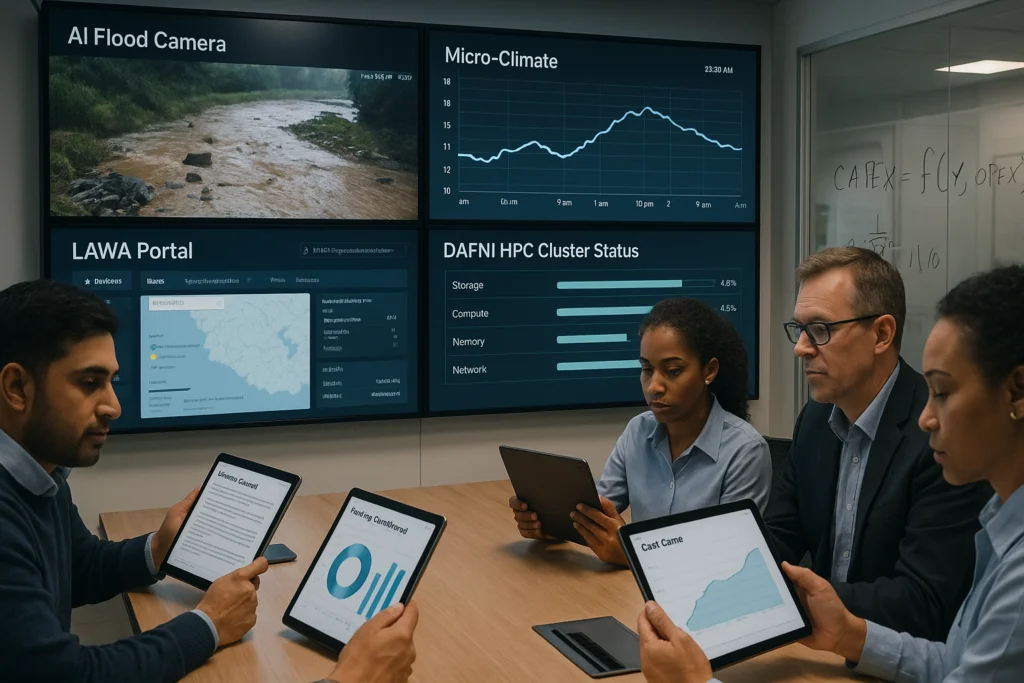
Technical Living Labs Infrastructure Analysis for Storm Water & Urban Heat Solutions
Recent campus based “living laboratories” in New Zealand, Australia and comparator regions have matured from small trials into data rich pilots wired to open access sensor grids and underpinned by legally binding data-sharing frameworks. These labs now feed directly into citywide procurement and maintenance budgets, proving a full pathway from pilot – evidence – policy – scale. The Living Labs Infrastructure Analysis below dissects that pathway across four principles critical to EcoWave.Green’s mission.
University Led Living Lab Testbeds
Definition
Real world precincts usually on university property where new storm water or heat mitigation assets are installed, metered and publicly reported for two or more climatic cycles.
Evidence & Metrics
| Site (Region) | Key quantitative findings | Programme notes | Source |
|---|---|---|---|
| Ngā Mokopuna / Living Pā (Wellington, NZ) | Captures 100 % potable water from rain; exports 105 % electricity surplus; diverted 1 120 t construction waste (Dec 2024) | Certified Living Building; baseline for temperate closed-loop design | (Victoria University of Wellington) (Wellington Scoop) |
| Te Puhinui Living Lab (South Auckland, NZ) | NZ $30 m catchment-scale regen plan; wetlands monitored across 35 km² | Lab anchors council storm-water consents | (Auckland Council) |
| Sydney Nano Living Lab (Sydney, AU) | Nano-coated paths measured 7 °C surface cooling on peak-sun test day (2024) | Data feeds campus-wide cool-surface rollout | (The University of Sydney) (The University of Sydney) |
Implications for EcoWave.Green
Living lab metrics supply “bankable” evidence that de risks wider adoption. EcoWave can replicate the closed loop water energy model proven at Living Pā for mixed use developments and cite Sydney’s nano coating results when proposing cool surface specs to councils.
Open Sensor & Monitoring Platforms
| Deployment (Region) | Sensor density / refresh | Notable outcomes | Source |
|---|---|---|---|
| AI flood-camera network (Auckland) | 23 cameras live; alerts within < 3 min; 27 more funded | Forms first-line defence in NZ $760 m, 10-yr “Making Space for Water” strategy | (Local Matters) (Auckland Council) |
| High-resolution LiDAR (Auckland) | 250 pts m-² over 560 km² (Jun 2025) → 20× older grid | Drives new flood-risk zoning models | (OurAuckland) |
| Micro-climate sensor API (Melbourne) | Ambient T°, PM 2.5/10, RH updated every 15 min; open download | Enables third-party heat-island analytics | (CoM Open Data Portal) |
| UrbanHeatSense LoRaWAN (London, EU comparator) | 43 nodes at £30 ea; +24 under build (Jul 2025) | Citizen-science model for low-cost grids | (Phoenix) |
Analysis Dense, open feeds convert isolated extreme weather events into granular datasets that validate hydraulic/thermal models. Auckland’s LiDAR resolution leap illustrates how one high spec survey can recalibrate design storms city wide; Melbourne’s API shows that even hourly micro climate data can be democratised without privacy barriers.
Data Sharing & Governance Agreements
| Framework | Scale & mandate | Relevance to EcoWave | Source |
|---|---|---|---|
| LAWA – Land, Air, Water Aotearoa | 1 500 + river sites; harmonised licences across all NZ regional councils | Template licence text for hydrology datasets | (Land, Air, Water Aotearoa (LAWA)) |
| NZ National Adaptation Framework (draft, Jul 2025) | Embeds open climate-risk data requirement for every council | Legal lever for mandating EcoWave sensor data | (Ministry for the Environment) |
| DAFNI upgrade (UK) | £4 m Centre of Excellence (2023) to federate infrastructure datasets on a national HPC platform | Reference architecture for cross-sector data federation | (Wikipedia) (UK Research and Innovation) |
Analysis Strong licences and cloud platforms reduce transaction costs and establish trust. EcoWave can port LAWA’s permissive schema to its own Eco Atlas, while citing NZ’s framework and DAFNI’s compute backing when negotiating with councils wary of data sovereignty.
Living Labs Infrastructure Analysis Impact to Scale Pathways
| Pilot → Scale | Quantified impact | Funding / policy lever | Source |
|---|---|---|---|
| Phoenix Cool Pavement (US) | Treated roads run 10.5–12 °F cooler at noon; > 130 mi coated since 2020 | Folded into annual street-maintenance budget | (Phoenix) (Smart Cities Dive) |
| San Antonio Cool Pavement (US) | US $1 m pilot across 10 council districts; UTSA monitors efficacy | Funded via Resiliency & Sustainability Fund | (San Antonio) (San Antonio Report) |
| Tullstorpsån Wetland Restoration (Sweden) | 39 wetlands, 10 km stream restored; 169 ha wetland area | Landowner co-op guides replication in neighbouring basins | (Tullstorpsån) (European Environment Agency) |
Scaling Logic Cool surface pilots succeeded once cost per lane mile fit routine resurfacing budgets; wetlands scaled through local ownership plus EU recognition. EcoWave should therefore embed life cycle cost and co benefit metrics in every brief, ensuring post-pilot OPEX slots into existing funding lines.
Cross Cutting Insights & Recommendations for EcoWave.Green
- Couple pilots with open sensors – without real time cameras and LiDAR, floods and heat waves remain anecdotal; granular evidence persuades treasuries.
- Adopt licence text early – re use LAWA’s clauses to pre empt data sharing friction.
- Budget for scale from day 1 – Phoenix shows capital costs fall when treatments piggy back on standard maintenance.
- Leverage grant rules that force openness – MBIE “Smart Ideas” and AIA Upjohn both bake dissemination into contracts, aligning with Eco Wave’s transparency ethos.
- Publish life cycle metrics, not slogans – councils react to kWh saved, peak flow reduced, degrees cooled. Living Pā’s closed loop stats and Tullstorp’s hectares restored offer replicable KPI sets.
By integrating these elements into its project pipeline, EcoWave.Green can transition from isolated exemplars to region wide adoption delivering cooler, flood resilient precincts backed by hard data and legally durable sharing frameworks.
Q1: How do living labs speed up council adoption of storm-water technology?
A1: By publishing sensor verified results that slot directly into procurement templates, living labs cut risk and shorten approval cycles.
Q2: Which open data licence best fits hydrology datasets in NZ?
A2: LAWA’s Creative Commons based licence is widely accepted by every regional council, so re using it prevents legal delays.
Q3: What grant clauses ensure sensor transparency?
A3: MBIE “Smart Ideas” (NZ) and ARENA Advancing Renewable (AU) both require recipients to publish API ready datasets within 12 months, guaranteeing open access.
Read More:
Living Labs Infrastructure >>>
Storm Water Strategies >>>
Net-Zero Precinct Evidence >>>
Green Roof Metrics >>>