Institutional research sustainable urban Storm Water Urban Heatdevelopment shows councils, ministries, PPPs drive greener cities with policy, finance, tech tools Research

Sustainable Social Economic offer urban practitioners a framework that integrates economic activity although with social equity and ecological limits. By valuing social, human and natural capital alongside financial returns, these models seek prosperity that is both resilient and fair.

Historical foundations and equity focused principles Sustainable Social Economic

Early precedents show that profitability significantly, can coexist with broad social benefit. Tomáš Baťa’s 20th-century company towns in Zlín linked wages to housing, health care and education, demonstrating “capitalism with a conscience.” In Spain, the Mondragón cooperative network channels profits to worker-owners, while Eco villages such as Findhorn (Scotland) and Torfolk (Sweden) fuse green building, also local food and participatory governance. Common principles include:

  • Community ownership of productive assets.
  • Democratic decision-making to distribute surplus and risk.
  • Stewardship of local resources to maintain long-term viability.

Current trends and measurable benefits

Recent although innovations (2024–2025) reinforce the model’s practicality:

  • Community wealth building keeps institutional spending local; Preston (UK) tripled local procurement between 2013 and 2017, boosting employment.
  • Localized economies generate higher multipliers—independent retailers reinvest ≈52 % of revenue locally versus 14 % for chains.
  • Cooperatives and DeFi democratise capital; Québec hosts 3,300+ co-ops employing 116,000 people.
  • Green micro-enterprises adopt circular practices, cutting waste and creating niche jobs.

The resulting impacts are well documented: localized supply chains improved pandemic resilience, and citizen-owned energy projects like Samsø (Denmark) achieved 100 % renewable while generating income for public services (State of Green). Economic resilience, green job creation and stronger social cohesion converge to improve public health and civic engagement (OECD policy brief).

Implementation challenges and enabling solutions Sustainable Social Economic Tech

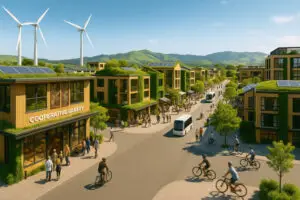
Scaling remains difficult because policies favor conventional corporations, and small initiatives lack capital. However, four strategies are emerging:

  1. Supportive public policy—e.g. Scotland’s draft Community Wealth Building Act embeds social value in procurement.
  2. Public-private-community partnerships that co-design assets while preserving local stewardship.
  3. Capacity networks such as the Global Eco village Network for knowledge transfer.
  4. Innovative finance—municipal green bonds and community investment funds lower the cost of capital.

Next steps: Practitioners should map local anchor-institution spending, assess cooperative viability and incorporate circular design from project inception.

Technical

Global Insights Green Tech

Global Insights Green Tech

Global Insights Green Infrastructure research. Reveals that urban sustainability advances fastest when cities treat climate solutions as shared intellectual capital rather than proprietary assets. The
Read More »
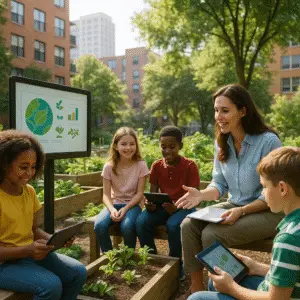
Education Strategies Tech empower communities and drive the success of green infrastructure projects. This comprehensive guide explains how formal education, informal learning, and community outreach raise eco-literacy, promote climate awareness, and foster public engagement in green initiatives. It highlights 2024–2025 trends – from gamified learning apps and AR experiences to citizen science and participatory urban planning – that make environmental education interactive and inclusive. The benefits of these efforts include informed behavioral change, community buy-in, and long-term stewardship of green projects. Real-world campaigns (e.g. youth tree-planting movements, “greening” schools, urban forest citizen programs in New Zealand, Australia and beyond) demonstrate how educating and inspiring people leads to sustainable, resilient communities.

Education Strategies Tech

Education Strategies Tech in Sustainable Development Indeed Education strategies tech plays a central role in driving sustainable development in Australia. As communities face urgent climate

Read More »
Automation Sustainable Development Tech Research

Automation Sustainable Development Tech

Automation Sustainable Development Tech Automation Sustainable Development Tech is rapidly reshaping sustainable urban development across Australia. By integrating artificial intelligence (AI), real-time data, and smart

Read More »

Q1. What is Sustainable Social Economic Tech?

A1. Sustainable Social Economic Tech is a forward thinking framework that merges modern technology with social equity principles and ecological limits. In doing so, it ensures that communities can thrive economically and socially, all while staying within the boundaries of what our planet can sustain. 

Q2. How can Australian or New Zealand councils adopt this approach?

A2. To begin with, councils in Australia and New Zealand can initiate community wealth building programs. Furthermore, they could issue local green bonds to fund sustainable initiatives. In addition, embedding cooperative ownership models directly into infrastructure contracts can ensure long term local benefit and community engagement.

Q3. Which local case studies demonstrate successful implementation?

A3. For instance, Byron Shire’s development of community owned solar farms illustrates how local energy can be both green and democratically managed. Similarly, the Wellington Community Trust’s implementation of green micro finance schemes showcases the viability and impact of these principles when applied at the community level.

Read More:
Sustainable Social Economic FAQ >>>
Sustainable Social Economic >>>
Life-Cycle Economics Hub >>>
Policy Funding Levers >>>
Net-Zero Districts Hub >>>