Green Infrastructure Sustainable Cities – Tech
Green Infrastructure Sustainable Cities: Key Benefits
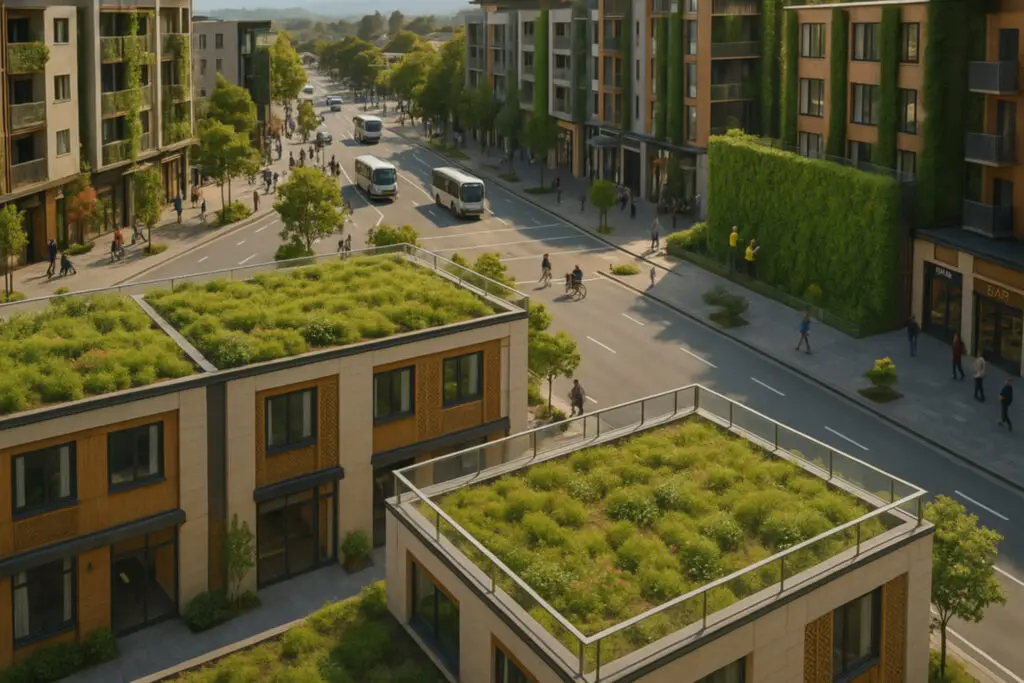
Weaves living systems rooftops planted with sedums, tree lined streets, rain absorbing soils into urban fabric, replacing or complementing grey pipes and concrete to deliver critical ecosystem services. However, maintenance costs drop after the first year.
Definition & Scope
Green infrastructure (GI) is a strategically planned network of natural and semi natural areas that delivers. Furthermore multiple ecosystem services while enhancing biodiversity. It includes:
- Green roofs / walls that insulate buildings and absorb rainfall (e.g., Milan’s Bosco Verticale sequesters ≈ 20 t CO₂ yr-1).
- Urban forests & street trees lowering air temperatures by 2 – 4 °C during heatwaves.
- Permeable pavements, rain gardens, bios wales that mimic wetlands and cut peak runoff by up to 42 %.
Unlike single purpose grey systems, GI is multi functional and often less expensive over its life cycle (European Commission).
Economic Value of Green Infrastructure in Sustainable Cities
Environmental. Vegetation not only … but also cools neighborhoods and traps pollutants; Philadelphia’s program prevents > 3 billion gal yr-1 of storm water from entering sewers. Economic. Proximity to community gardens raised New York property values ≈ 9 %, and benefit cost ratios for well planned GI reach 17:1. Social. Access to green space correlates with reduced stress and higher physical activity; equitable distribution of parks and street trees advances environmental justice.
Implementation Challenges & Evolving Solutions Green Infrastructure Sustainable Cities
- Up front finance. High initial costs indeed are eased through rebates, climate bonds, and public private partnerships (e.g., NYC’s US$58 M green rooftop fund).
- Maintenance. Living systems need care; many cities embed stewardship contracts or community adoption, reinforced by IoT soil moisture sensors that trigger smart irrigation.
- Policy alignment. Updated storm water codes and mandatory green roof bylaws (Toronto, France) mainstream GI into building practice. Consequently, storm sewer upgrades can be deferred.
Emerging Trends & Case Snapshots (2024 – 2025)
Blue green roofs. Amsterdam now hosts > 10 000 m² of roofs that store rainwater beneath vegetation, boosting flood resilience. AI enhanced planning. Algorithms map optimal subsequently tree planting sites for maximum cooling. Regional proof. Melbourne’s “4 °C Cooler” program. E planted 15 000 trees; Whangārei’s forest roof merges Māori principles with biodiversity as well as conservation in a humid maritime climate.
Green Infrastructure Sustainable Cities in Action
Green Infrastructure Sustainable Cities seeking furthermore heat, flood and nature positive growth should embed GI metrics in master plans. Pair living systems with digital monitoring, and share lessons via international networks. Meanwhile, residents enjoy cooler streets and cleaner air.
Technical

Global Insights Green Tech
Global Insights Green Infrastructure research. Reveals that urban sustainability advances fastest when cities treat climate solutions as shared intellectual capital rather than proprietary assets. The

Education Strategies Tech
Education Strategies Tech in Sustainable Development Indeed Education strategies tech plays a central role in driving sustainable development in Australia. As communities face urgent climate

Automation Sustainable Development Tech
Automation Sustainable Development Tech Automation Sustainable Development Tech is rapidly reshaping sustainable urban development across Australia. By integrating artificial intelligence (AI), real-time data, and smart
Q1: What is green infrastructure technology?
A1: It blends living systems green roofs, tree canopies, permeable pavements with sensors and smart irrigation to manage heat and floods while cutting life cycle costs.
Q2: How much cooler can green infrastructure make a city?
A2: Urban forest data shows mature tree canopies lower street temperatures by 2 – 4 °C during heatwaves, and Melbourne targets a 4 °C city wide drop through its planting programme.
Q3: Is green infrastructure cheaper than grey pipes in the long run?
A3: Studies in the EU cite benefit cost ratios up to 17 : 1 when accounting for storm water savings, energy cuts, and health benefits.
Read More:
Green Infrastructure Resilient Cities >>>
Green Infrastructure Sustainable Cities FAQ >>>
Green Infrastructure and Strategy >>>
Storm Water Strategies Analysis >>>
Living Rooftops Gardens Tech >>>