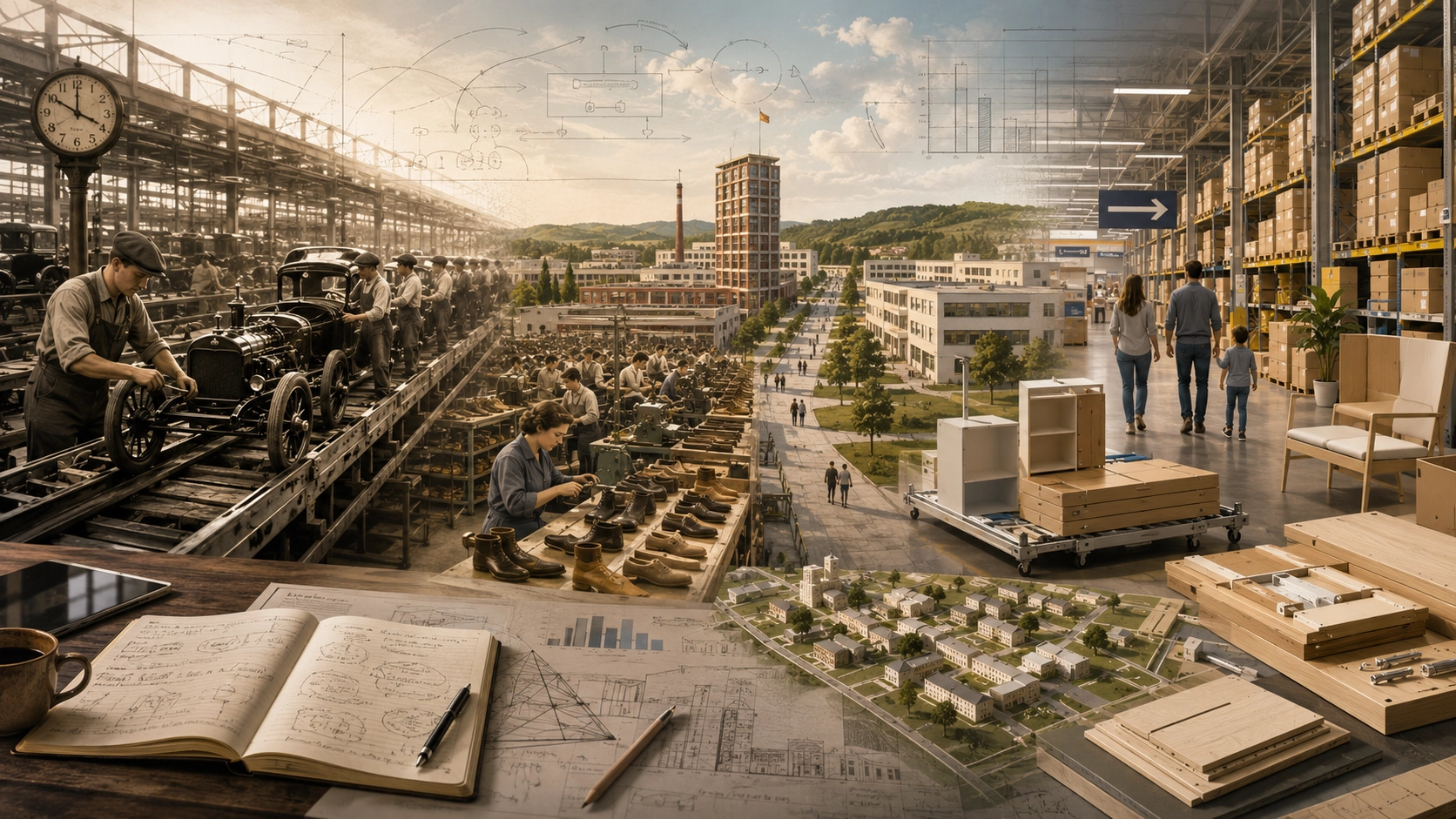
Ford Motor Company: simplify before scaling
Ford Motor Company is useful here as a productivity case study, not as a complete sustainability model. Ford’s moving assembly line at Highland Park changed car manufacturing by bringing work to workers and reducing Model T assembly time to about 90 minutes.
Ford also introduced the $5 workday in 1914 as a profit-sharing wage policy that helped retain workers and attracted more people to Detroit. However, the wider Ford system also included intrusive social monitoring through the Sociological Department, so the lesson should be handled carefully.
For Eco Wave Green, the safer lesson is not to copy Ford’s full social model. The useful pattern is to simplify the process, measure bottlenecks, share gains fairly where possible, and check whether scale creates human or environmental costs that need to be managed.
Verified pattern
– Moving assembly line adopted at Highland Park in 1913.
– Model T assembly time reduced to about 90 minutes.
– $5 workday introduced in 1914, with conditions attached.
– Main lesson: simplify workflow before scaling.
– Main caution: productivity systems can create social risks if worker wellbeing and autonomy are ignored.
Baťa Zlín: connect work, learning and place
Baťa Zlín shows how productivity can be linked to training, workshop-level accountability, worker housing, in-house engineering and long-term urban planning. The company’s model connected production, skills, transport, housing and management information as parts of one operating system.
Official Baťa material supports strong growth, but the figures should be stated carefully. By 1938, Baťa had about 65,000 employees, factories and affiliated companies in 39 countries, and 5,500 shoe stores.
For Eco Wave Green, the useful lesson is system design. A productive model is not only a technology or a building. It depends on people, skills, evidence, logistics, maintenance and local context working together.
Verified pattern
– Workshop level accountability and profit-sharing were part of the Baťa management model.
– Baťa developed in-house engineering, training, social infrastructure and garden-city planning around Zlín.
– By 1938, Baťa had about 65,000 employees and companies or affiliates in 39 countries.
– Main lesson: productivity improves when skills, place, management and operations are designed together.
– Main caution: historical company towns should not be copied without modern safeguards for choice, fairness, governance and public benefit.
IKEA: modular design and resource efficiency
IKEA is useful here as a case study in modular design, logistics discipline and resource-efficiency goals. Flat-pack furniture, standardised components and customer co-assembly helped the company reduce handling complexity and make design more affordable for mass markets.
The sustainability claims need careful wording. IKEA’s FY13 sustainability report supports claims such as 98% of main home-furnishing materials and packaging being renewable, recyclable or recycled; 87% of operational waste sorted for recycling; renewable energy production equivalent to 37% of total energy consumption; and a 10.5% reduction in transport-related CO₂ emissions per cubic metre of products shipped compared with FY11.
For Eco Wave Green, the useful lesson is modularity, not imitation. Any future modular product, kit, service or research output should be tested for safety, repairability, funding, demand, environmental effect and end-of-life handling before strong public claims are made.
Verified pattern
– Flat-pack and standardised design reduced handling complexity.
– IKEA’s FY13 report stated that 98% of main home-furnishing materials and packaging were renewable, recyclable or recycled.
– IKEA’s FY13 report stated that 87% of operational waste was sorted for recycling.
– IKEA reported a 10.5% reduction in transport-related CO₂ emissions per cubic metre shipped compared with FY11.
– Main lesson: modular design can reduce complexity when the whole system is designed around it.
– Main caution: efficiency claims must be tied to dated, source-backed metrics.